
Senator John Heinz

RELATED NEWS

  • Beverly Wright is interviewed on NPR's "Living On Earth" go >>
  • August Wilson's boyhood home to become a workshop for artists, musicians and writers go >>
  • Dave Eggers one of the winners of the 31st annual American Book Awards go >>
  • Ashok Gadgil appointed Director of the Environmental Energy Technologies Division of Lawrence Berkeley National Laboratory go >>
  • Richard Lugar writes an Op-Ed for the New York Times on child nutrition programs go >>
  • Ann Hamilton creates new installation for the Pulitzer Foundation for the Arts go >>
  • Mark di Suvero exhibit opens at the Paula Cooper Gallery go >>
  • At 90, Russell Train and his environmental work is profiled on MSNBC go >>
  • Dave Eggers co-authors an Op-Ed piece on Sudan in the New York Times go >>
  • Heinz Awards Chairman Teresa Heinz co-authors editorial on cancer and green chemistry go >>
  • Dr. Butler, gerontologist and psychiatrist, the founding director of the National Institute on Aging, dies at 83 go >>
  • Jacques D'Amboise and the National Dance Institute to perform with young dancers in Shanghai via telepresence technology go >>
  • Andrew Grove writes an Op-Ed piece on job creation and unemployment in the United States go >>
  • James Nachtwey photographs from Iraq field hospitals part of photojournalism show at The Getty go >>
  • Inspired by Bernard Amadei, Israeli students start a Engineers Without Borders chapter and create a project in Nepal go >>
  • James Hansen is awarded the 2010 Sophie Prize go >>
  • James Hansen is co-recipient of the 2010 Blue Planet prize go >>
  • Robert Berkebile pens Op-Ed on energy and oil in Kansas City Star go >>
  • Arthur Mitchell named honorary chairman for 2010 USA International Ballet Competition go >>
  • Colorado Renewable Energy Society presents its 2010 Larson-Notari Award to Amory Lovins go >>
  • James Hansen co-authors paper stating that the global temperature this year reached the warmest average on record go >>
  • Arthur Mitchell's Dance Theater of Harlem honored at California African American Museum go >>
  • Dave Eggers and 826 Valencia links college bound students and donors with Scholar Match site go >>
  • Bernard Amadei inducted as an Ashoka Fellow go >>
  • Amory Lovins inducted as an Ashoka Fellow go >>
  • Jacques D'Amboise to perform for non-profit Kids Excel in El Paso fundraiser go >>
  • Paul Ehrlich interviewed by "Green" blog at New York Times go >>
  • Mario Molina named to IPCC review committee go >>
  • Leroy Hood is awarded the 2010 Kistler Prize from Foundation for the Future go >>
  • Lifetime achievement award presented to John Spengler by the EPA go >>
  • Dorothy Height, a leading female voice of the 1960s civil rights movement, dies at 98 go >>
  • President Obama nominates Donald Berwick to head the Centers for Medicare and Medicaid Services go >>
  • John Harbison and Michael Beattie prepare to hand over reins of Emmanuel Music go >>
  • John Harbison's double concerto world premiere completes the Boston Symphony Orchestra season go >>
  • Ashok Gadgil chosen by NASA as one of 10 Top Innovators on Water Sustainability go >>
  • Leroy Hood and the Institute for Systems Biology profiled in The Seattle Times go >>
  • Robert Berkebile's firm, BNIM, to lead master planning for Chatham University's campus in Gibsonia, PA go >>
  • Slate compares Steve Wozniak's design of the original Apple computer to today's iPad go >>
  • Richard Goldman named UC Berkeley Alumnus of the Year go >>
  • "August Wilson's Women" is staged at the Nuyorican Poets Cafe in New York City go >>
  • Scholar edits second volume of essays on August Wilson cycle of plays go >>
  • Ann Hamilton honored by University of Kansas with Alumni Distinguished Achievement Award go >>
  • Robert Moses co-authors a new book (with Ernesto Cortes) on creating a grassroots movement to transform public education go >>
  • Ernesto Cortes co-authors a new book (with Robert Moses) on creating a grassroots movement to transform public education go >>
  • Bernard Amadei leads development initiative in Haiti documented by Rocky Mountain PBS go >>
  • James Nachtwey's photography project on tuberculosis featured in the New York Times' Lens blog go >>
  • Leroy Hood co-authors paper in Science on the first whole genome sequencing of family of four go >>
  • Hugh Herr is profiled in The O&P Edge go >>
  • Hugh Herr is profiled in The Economist go >>
  • Dave Eggers makes Ad Age's Creativity magazine's 50 list for 2010 go >>
  • Bruce Katz is profiled in Next American City go >>
  • Chris Field and PG&E Chairman Peter Darbee release white paper on climate change for business leaders and policymakers go >>
  • Dave Eggers wins first Innovators Award from the LA TImes Book Awards go >>
  • James Nachtwey featured in exhibition on world events go >>
  • Beverly Wright interviewed about environmental justice on Living on Earth go >>
  • Jane Lubchenco announces National Climate Service at NOAA go >>
  • Heinz Awards Chairman Teresa Heinz urges women to get annual mammogram in Pittsburgh Post Gazette editorial go >>
  • Dee Boersma is featured on ABC Nightly News go >>
  • Paul Farmer interviewed on PBS NewsHour regarding delivery of aid in Haiti go >>
  • Jerry Franklin co-authors Op-Ed on how logging federal lands requires a fresh approach go >>
  • Paul Farmer interviewed on 60 Minutes regarding the crisis in Haiti go >>
  • Paul Farmer pens Op-Ed on Haiti in Miami Herald go >>
  • Dave Eggers among Poets and Writers magazine's "Fifty of the Most Inspiring Authors in the World" go >>
  • Jerry Franklin co-authors editorial in The Oregonian supporting Oregon forests bill go >>
  • Christopher Field co-authors study that links global warming to shifting ecosystems go >>
  • Peggy Shepard co-authors editorial in issue of Environmental Justice journal go >>
  • Hugh Herr and his prosthetics research are profiled in Forbes magazine go >>
  • Rick Lowe receives 2009 United States Artists Fellowship go >>
  • U.S. Senator Dick Lugar named one of the 25 greatest public servants over the past 25 years go >>
  • Bruce Katz co-authors article in The New Republic on revitalizing Detroit go >>
  • The new book, "Storms of My Grandchildren" by James Hansen, released today go >>
  • Geoffrey Canada and the Harlem Children's Zone profiled on 60 Minutes go >>
  • Brenda Krause Eheart receives a 2010 AARP Magazine Inspire Award go >>
  • John Holdren makes Foreign Policy's first annual list of 100 top global thinkers go >>
  • James Hansen makes Foreign Policy's first annual list of 100 top global thinkers go >>
  • Amory Lovins makes Foreign Policy's first annual list of 100 top global thinkers go >>
  • Paul Farmer makes Foreign Policy's first annual list of 100 top global thinkers go >>
  • Bernard Amadei is recipient of 2009 Honorary Member Award from the National Groundwater Association go >>
  • Chip Giller and grist.org profiled on Voice of America go >>
  • Kirk Smith co-authors a six paper series in The Lancet on the direct health benefits of reducing carbon dioxide and other greenhouse emissions go >>
  • Dee Boersma highlighted in Washington Post article on penguins' role as environmental indicators go >>
  • Joel Salatin is profiled in the Christian Science Monitor go >>
  • Aaron Beck presented with the Anna-Monika Prize for lifetime achievement go >>
  • Paul Farmer writes an Op-Ed on juvenile offenders for the Boston Globe go >>
  • Joel Salatin is a speaker at TEDx MidAtlantic go >>
  • The London Times writes about a new nanotechnology cancer therapy co-developed by Robert Langer go >>
  • Dave Eggers wins 2009 Prix Medicis for best foreign work go >>
  • Geoffrey Canada named 2010 winner of the Brock International Prize in Education go >>
  • Hugh Herr profiled in The Jerusalem Post go >>
  • Geoffrey Canada receives Robert Coles Award from Harvard group go >>

The Heinz Awards

2008

Joseph DeRisi

Joseph DeRisi receives the Heinz Award in Technology, the Economy and Employment for his extraordinary breakthroughs in detecting both new and existing viruses.

An innovative and selfless scientist, Dr. Joseph DeRisi's breakthrough creation of a viral detection platform for malaria and other infectious diseases has helped advance biomedicine's ability to detect both existing and new viruses. As a professor of biochemistry at the University of California, San Francisco, where he also holds the post of Howard Hughes Medical Investigator, he is one of the world's foremost researchers in the application of molecular genomics to the study of infectious disease.

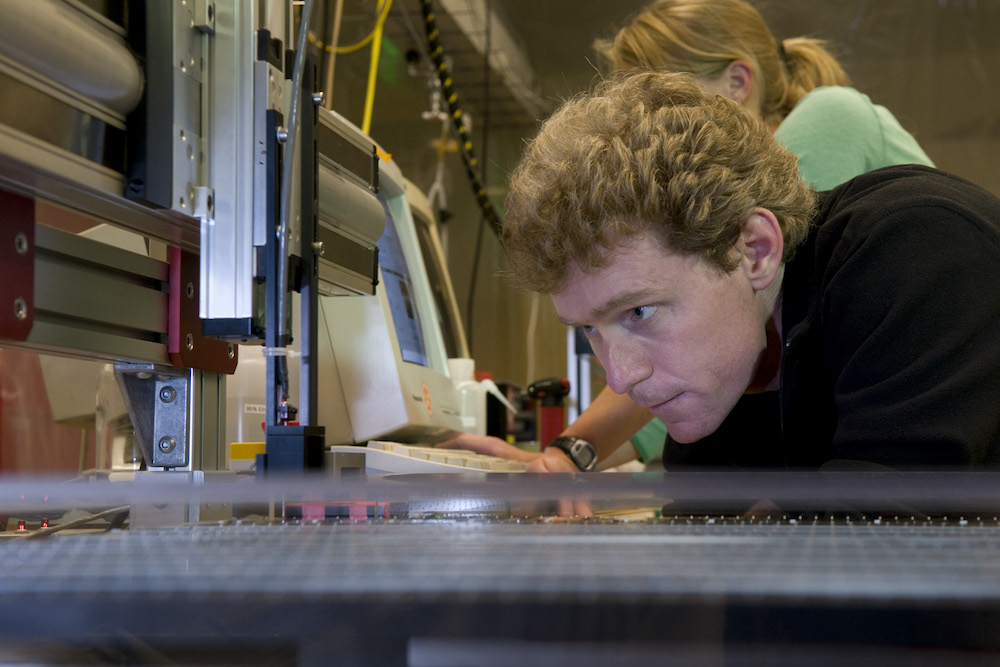
Dr. DeRisi stands at the intersection of the disciplines driving the life sciences - genomics, bioinformatics, virology, materials science and computer engineering. Together with his longtime collaborator, Dr. Don Ganem, he pioneered the development and use of the ViroChip, a band-aid-sized glass wafer that contains a microarray of 22,000 DNA sequences from more than 1,300 viral families. This "diagnostics on a chip" enables scientists to not only quickly and accurately identify existing viruses, but also to detect new viruses that could emerge as pandemic threats. In 2003, the ViroChip identified the SARS virus within 24 hours of receiving the sample from the U.S. Centers for Disease Control and Prevention.

Befitting his commitment to open access publishing within the scientific arena, Dr. DeRisi has not pursued a patent for the ViroChip, allowing researchers around the world to use the invention for free.

Notwithstanding his work in virus detection, Dr. DeRisi's primary focus has been on finding a cure for malaria, a disease that infects up to 500 million people annually, killing between 700,000 and 2.7 million, mostly children. He and his team developed a malaria-specific DNA chip, similar to the ViroChip that enabled them to characterize the parasite's distinctive 48-hour life cycle, a breakthrough that could pave the way for potential drug and vaccine therapy.

As part of the California Institute for Quantitative Biosciences, a cooperative effort among three campuses of the University of California and private industry, Dr. DeRisi's laboratory is working to apply the quantitative sciences (mathematics, physics, chemistry and engineering) to biosciences toward improving human health. He also has taken on a number of other challenges, from investigating a cure for the common cold to an analysis of the disappearance of a half-million honeybee colonies in the United States, a situation that could have a viral culprit at its roots.

Joseph DeRisi has made breakthrough discoveries in the laboratory that have provided clarity and insight into the detection of some of the world's most threatening viruses as well as distinguished himself as a generous and tireless advocate for the free and open sharing of scientific research. With a brilliant mind and expansive heart, he has ennobled the field of science.

Note: This profile is excerpted from the commemorative brochure published at the time of the awards' presentation.

Speech

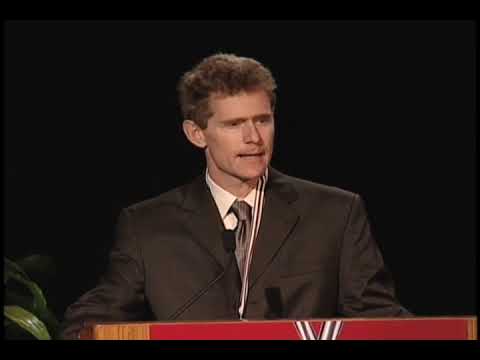
10/21/2008 - Acceptance Speech

Many, many, many thanks are in order especially to Teresa Heinz and the Heinz Family Foundation. This is a tremendous honor for me.  As a molecular biologist, as any current biologist, we stand on the shoulders of giants and I have those giants that came before me to thank, as well.  But I also must thank my family for their unwavering support: my wife Suzanne, my parents, Bill and Ruth, and my sister, Maria, who could be with me here right now.  And as a scientist, we rely on crucial mentorship.  And I’ve received amazing mentorship throughout my career, without which I would not be here by dozens of outstanding people beginning with public school actually in Sacramento, California, extending through UC, Santa Cruz where I went to undergraduate and Patrick Brown, my mentor at Stanford University.  Which really illuminated, he illuminated for me completely new approaches to biomedical research and just opened my mind to how things could be done.  And now I’m at the fantastic research environment-UC, San Francisco which is nurturing this new effort to pursue global health as an initiative and priority.

I also need to thank my lab because, although I do still get into the lab now and then, it’s really my lab that does all the work that you see today.  And my close collaborator, Don Ganem and the other people at UCSF that help me.  And the people who make the work possible Herb: and Marion Sandler, the Strategic Program for Asthma Research, the Packard Foundation and the Howard Hughes Medical Institute.

And so, I really don’t have that time to say much else, other than to remind you that we actually live in a very unusual period where the political climate has been especially hostile and damaging to science in a way that it has never been before.  From stem cells to evolution to global warming; from a strangled NIH to for-profit entities that seek to stratify and ultimately restrict what science you as the public actually have access to read.  We stand now, literally to lose a completely whole generation of scientists, and with them, I remind you, the next biomedical achievements that will save lives here and in every country around the world.

This needs to change!  Thank you very much.

Joseph DeRisi
Joseph DeRisi