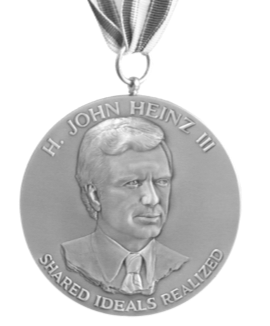

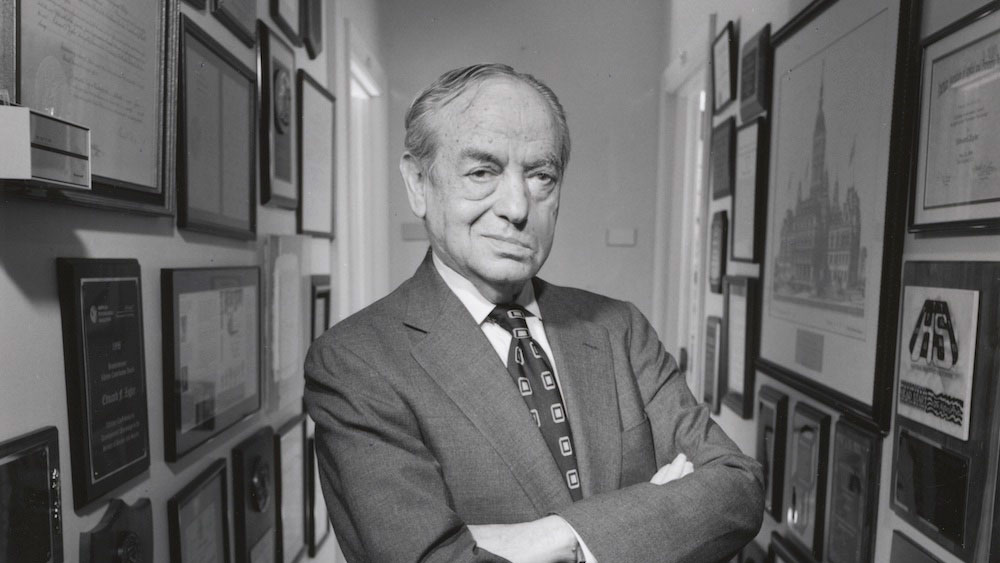
Dr. Edward Zigler receives the Heinz Award in Public Policy for his work in championing Head Start, the pre-school program that has served some 18 million at-risk children and their families in its 35 years of existence. In 1999 alone, over 800,000 youngsters were the beneficiaries of Dr. Zigler's dedication to their education, health, nutrition and emotional well being.
As a young professor at Yale University in the 1960s, Dr. Zigler found himself in the center of increased federal interest in encouraging the proper learning environment for children during their early years. Educators were discovering that poor children, often from inner cities, were ill equipped to learn when they entered school. Experts theorized that inadequate preparation for school contributed to many of the problems that surface later in life. Dr. Zigler, already distinguished by his research on mental retardation and early child development, moved to the forefront of this new investigation in 1964 when he was asked by the White House to join a panel of experts commissioned to design a national intervention program for poor children ages three to five. This pre-school program came to be known as Head Start.
Dr. Zigler, however, led the effort to create a program that would do more than provide educational tools for these children. Partly as a result of his advocacy, Head Start was designed to include nutrition counseling, health screenings and a parental education and involvement component. It was launched nationally in 1965, serving over 500,000 children in its first summer. Five years later, Dr. Zigler again fought for his beliefs when he led efforts to improve the program and save it from proposed elimination after a report questioned its effectiveness. Later, he was named by President Nixon to be the first director of the Office of Child Development (now the Administration on Children, Youth and Families), and chief of the U.S. Children's Bureau. In that role, he conceived such innovative programs as Home Start and the Child Development Associate (CDA).
Dr. Zigler's courage and integrity were again demonstrated a few years ago at a time when Head Start was enjoying immense popularity and unprecedented budget increases. As the program's best friend, he publicly announced on page one of The New York Times that one third of the Head Start Centers were offering such poor service that they should be closed. It was not a headline-seeking ploy. Dr. Zigler was deeply worried that the program was expanding both too rapidly and without a cohesive plan, threatening the quality and the results for which he had fought so long and hard. While quick to point out problems, he was just as quick to roll up his sleeves and forge solutions. And while the man who has been called the "father of Head Start" shocked many with his remarks, he shocked them into action, resulting in higher quality services for children and their families and a better working environment for the staff.
Dr. Zigler has devoted 35 years to the development of sound programs for at-risk children. A model of dedication, determination and concern, he continues to have the courage to re-evaluate the program he helped create as he continues to search for new ways to improve the quality of life of America's children.
Note: This profile is excerpted from the commemorative brochure published at the time of the awards' presentation.
UPDATES SINCE RECEIVING THE HEINZ AWARD
July 2005 - Zigler is honored at a celebration for the renaming of the Yale (Bush) Center in Child Development and Social Policy. The center will now be called the Edward Zigler Center in Child Development and Social Policy in honor of its founder. - M2 Presswire
June 2003 - Zigler publicly disagrees with the Bush administration's proposals for change
to his Head Start program. Bush's pitch allows states to administer the Head
Start program, but Zigler believes this will come at the price of jeopardizing
Head Start's huge preschool population. He believes that the best way to serve
all age groups is to leave "the long-standing federal-to-local funding stream
over a state-to-local funding stream" like the one proposed by Bush. - The
Seattle
Post-Intelligencer
May 2003 - Zigler is honored with an award from the National Head Start Association at
its 30th annual training conference. The award honors "his four decades of
pioneering work in early childhood education". - Save Head Start website (www.saveheadstart.org)
February 2003 - The National Head Start Association presents the Edward Zigler Scholarship in
honor of Zigler's "dedication to Head Start children and families". The award
is to be given annually and includes a $3,000 scholarship. - American
Psychological Association website (www.apa.org)
December 2002 - Zigler receives a Lifetime Achievement Award at the 2002 First for Kids
Celebration, which honors individuals whose work has greatly impacted Connecticut's youth. The
award and the celebration are both presented by the Connecticut Voices for
Children organization. - Connecticut Voices for Children website (www.ctkidslink.org)
May 2001 - Zigler is awarded the Connecticut Higher Education Lifetime Achievement
Community Service Award. The award is presented to Zigler by the Board of
Governors for Higher Education in conjunction with the Commissioner of Higher
Education and the Connecticut Commission on National and Community Service for
all of his "special focus on work locally, with important collaborations with
schools and communities across Connecticut and with state-level policy makers." - M2 Presswire
I am truly grateful to the Heinz Foundation for this wonderful award. This award has special significance for me because it was established in memory of my old friend, John Heinz. John's legislative career was devoted to child- and family-friendly policies. I remember one of Head Start's darkest hours, when President Carter wanted to move the program to the new Department of Education. Such a move would have ended Head Start as we know it. The final decision was up to the Senate Operations Committee, where John Heinz was the ranking minority member. I worked with him at that point in time, and he proved to be a strong and effective proponent of keeping Head Start in the Department of Health and Human Services, where it could continue to deliver the comprehensive services directed by its original goals.
Thirty years ago I came to Washington to be Chief of the United States Children's Bureau and first Director of what is now the Administration on Children, Youth and Families. I was an academic scholar and was unprepared for the huge task that confronted me. I essentially had to learn on the job. I have now paid for my blunders in government by training many students in the new discipline of child development and social policy - - students who are now equipped to work at the intersect of policy construction and our knowledge base in human development.
They have a lot of work to do. I have been involved with our nation's Head Start program for over 35 years, and it truly has had a Perils of Pauline existence. In campaign after campaign, the candidates routinely promise full funding for Head Start so all eligible children can attend. I remain skeptical and disappointed by these pledges. It has taken us 35 years to serve 40% of the children eligible for the program. If we continue at this rate, it will take 50 more years before all of them can go to Head Start. The one-in-five of our children currently growing up in poverty cannot wait 50 years.
None of our children can wait for more and better child care. My and our nation's biggest challenge is to see that every child who needs it receives good quality care. This includes care by the child's own parent in the early months of life - - something only a paid infant care leave could widely provide. When children do enter out-of-home care, we must do something to insure that it is good care. I cannot retire when I see so many of our children receiving care that is so poor in quality that their growth and development are compromised.
I was extremely fortunate to have Elliot Richardson as my mentor when I was in Washington. I, and the nation's children, owe Elliot a great deal. Like John Heinz, Elliot is no longer with us. I also owe a great deal to my wife, Bernice, and my son, Scott. My family made many sacrifices so I could do my work. To chip away at my debt, I will continue my efforts on behalf of children and families. I am encouraged by the Heinz Foundation's recognition of my accomplishments, even though they are not nearly enough.